Uzza
The Satanic VersesUzza is one of Jahilia’s three most beloved goddesses and the focus of a temple at the city’s northern gate. Associated with beauty and love, she belongs to a polytheistic order that Mahound’s new faith challenges and eventually displaces. Her story moves through worship, contested revelation, and destruction; in each stage, the novel makes her significance depend not only on what believers say she is, but on who claims the authority to name her.
Identity and Place in Jahilia
At the shrines of the three goddesses, Uzza appears beside Lat and Manat as part of an established religious order. The novel describes her as radiant in visage and associates her with beauty and love. Manat is linked to destiny, while Lat is presented as the highest of the three and as the goddess whose temple is controlled by Hind’s family. Their shrines are not merely devotional sites: the revenues from the temples underpin Abu Simbel’s wealth and position in Jahilia. Uzza’s temple, at the northern gate, is one element in that larger arrangement of worship and civic power.
Her presence also belongs to a wider landscape crowded with gods and idols. The House of the Black Stone holds three hundred and sixty idols, and the city’s religious life accommodates many divine figures. Within this setting, Uzza is not an isolated symbol but part of a public system of veneration. The novel’s later rejection of her authority therefore alters the meaning of a whole civic and religious order, rather than simply changing one individual’s private belief.
The Proposal and the Public Recitation
During Mahound’s negotiations with Abu Simbel, the possibility of recognizing Uzza, Lat, and Manat becomes a political and religious test. Abu Simbel offers Mahound acceptance and official recognition in Jahilia in exchange for approval of the three goddesses. The proposed compromise would make Mahound’s followers less vulnerable to persecution, but Salman the Persian warns that accepting it could also make Mahound appear fraudulent and undermine the creed his community has been reciting. The dispute makes Uzza’s standing a question of both faith and public legitimacy.
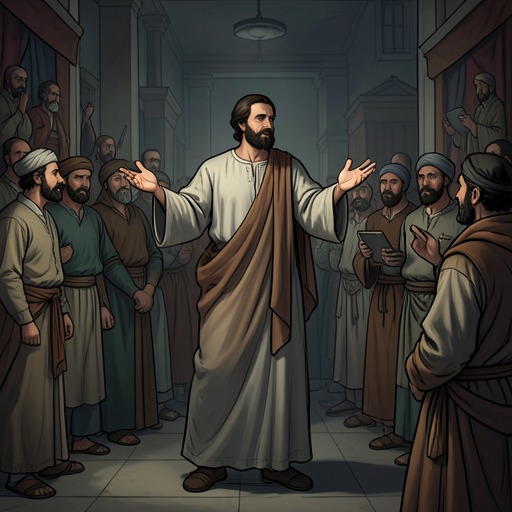
Mahound later appears at a gathering of poets and announces that he brings verses from a greater source. He recites a passage concerning Uzza and the other goddesses that acknowledges their intercession. The response in the tent and beyond it is immediate: Hind rises, and Abu Simbel and Hind bow in the public profession of faith. Their actions help turn the recitation into a communal event, and people across the gathering follow them in kneeling. Khalid, the water-carrier, watches in horror and flees. For the moment, Uzza’s name has entered the new message in a form that appears to make room for the old goddesses.
Retraction and the Problem of Authority
The apparent accommodation does not hold. After wrestling with Gibreel, Mahound wakes in the wilderness and concludes that the earlier verses came from the Devil rather than the angel. He returns to Jahilia to remove them from the true recitation. At the House of the Black Stone, he publicly abrogates the verses and replaces them with a declaration that the goddesses are names without divine authority. Uzza’s status is thus reversed by a change in the words attributed to revelation: she is first included as an object of intercession and then excluded from the new religious order.
The novel complicates any simple account of that reversal. In Gibreel’s narration, the same archangelic voice is implicated in both the original verses and their repudiation. The revelation’s authority is therefore entangled with uncertainty about who speaks and how speech becomes scripture. Much later, Salman the Persian recalls the episode and describes secretly altering the words he records for Mahound. That separate act of rewriting reinforces the novel’s attention to the fragile passage from spoken revelation to written text, without making Salman’s actions identical to the earlier dispute over Uzza.
The Temple’s Destruction and Narrative Significance
In Gibreel’s dream of Mahound’s return, Uzza’s temple stands beside the open gates of Jahilia. Mahound sends Khalid, formerly a water-carrier, to cleanse it before entering the city. The temple’s guardian tests Uzza’s power by asking the goddess to defend herself; when the idol remains still, he concludes that it is stone. Khalid breaks the idol and the temple, but Mahound orders him back because the first destruction has not, in Mahound’s view, completed the task.
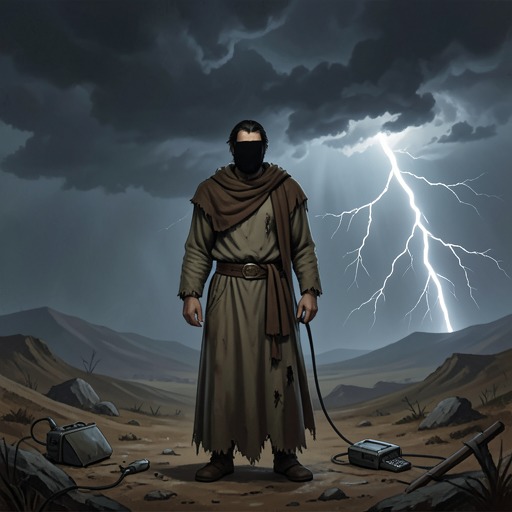
On the return, Uzza appears not as a radiant cult image but as an immense, terrifying woman who recites the verses previously associated with the goddesses. Khalid identifies those words as the Devil’s verses and rejects her claim to worship. He cuts her down, after which Mahound declares that the way into Jahilia is open. The sequence belongs to Gibreel’s dream, a framing detail that matters: the temple’s destruction is narrated as a visionary scene, not simply as a detached historical report. In the larger dream, the idols of the House of the Black Stone are also broken, and Jahilia submits to Mahound’s faith.
Uzza’s transformations give the episode its force. She is at once a named goddess embedded in Jahilia’s institutions, a figure briefly recognized in recited verses, and a demonic presence in a dream of religious conquest. The novel does not let those versions settle into an uncomplicated portrait of a deity. Instead, her changing representation exposes the struggle over who can define sacred speech, who can withdraw it, and what becomes of an older faith when a new authority claims the city.